Table of Contents
- What Dump Trailers Are Best for Residential Projects
- Understanding Dump Trailer Weight Capacity and Payload Limits
- Dump Trailer Rental Cost Per Day: Pricing Factors and What to Expect
- How to Load a Dump Trailer Safely: Step-by-Step Instructions
- Dump Trailer Rental vs Dumpster Rental: Which Option Fits Your Project
- Choosing the Right Trailer Size for Your Residential Cleanup
- Safety Guidelines and Regulations for Towing and Dumping
- Conclusion
Last Updated: August 19, 2026
What Dump Trailers Are Best for Residential Projects
A dump trailer is a heavy-duty hauling vehicle with a hydraulic lift mechanism that tilts the cargo bed upward, allowing materials to slide out the back during unloading. For residential projects, dump trailers offer a practical solution for moving construction debris, landscaping materials, yard waste, and renovation rubble. Unlike traditional flatbed trailers requiring manual unloading, the dumping mechanism saves time and physical effort.
At Urgency Trailer Rentals, we’ve helped homeowners and contractors understand which dump trailers work best for specific residential needs. A typical residential dump trailer ranges from 10 to 20 cubic yards, which suits most home renovation, landscaping, and cleanup projects. The real advantage is convenience: load materials once, drive to the disposal site, pull the hydraulic lever, and you’re done, no second trip to unload by hand.
Understanding Dump Trailer Weight Capacity and Payload Limits
The payload capacity of a dump trailer determines how much weight you can safely load before exceeding the trailer’s structural limits and the towing vehicle’s capacity. Every trailer has a Gross Vehicle Weight Rating (GVWR) that includes the trailer’s own weight plus cargo; exceeding this risks brake failure, tire blowouts, and liability issues.
For residential projects, most dump trailers have payload capacities between 5,000 and 15,000 pounds. A 10-cubic-yard trailer typically carries around 8,000 to 10,000 pounds safely; a 20-cubic-yard trailer can handle 12,000 to 15,000 pounds. The confusion arises because cubic yard capacity and payload capacity are independent measurements, a large trailer by volume might not hold as much weight as a smaller, heavier-duty model.
Most homeowners assume they can fill a trailer to the brim. You can’t. Soil, concrete, and landscaping materials are dense. A full 10-cubic-yard load of dirt or gravel can easily weigh 12,000 to 15,000 pounds, exceeding the payload limit on many residential trailers. Axle weight distribution also matters; uneven loading can cause one axle to exceed its limit while the other sits underutilized, creating dangerous handling characteristics.
When renting a dump trailer, ask the rental company for the exact payload capacity and GVWR. Estimate your load weight conservatively, especially with dense materials like concrete, asphalt, or wet soil.
Dump Trailer Rental Cost Per Day: Pricing Factors and What to Expect
Dump trailer rental pricing depends on trailer size, rental duration, distance traveled, local market rates, and material type. Several factors influence your final cost: trailer size (10-cubic-yard costs less than 20-cubic-yard), rental duration (weekly and monthly rates offer better per-day pricing), delivery distance, and material type.
Seasonal demand also affects pricing. Spring and summer see higher demand as homeowners tackle renovation and landscaping projects. Renting during peak seasons costs more than off-season rentals. If your project timeline is flexible, scheduling during fall or winter can reduce costs.
When comparing rental options, focus on total project cost, not just the daily rate. A company charging slightly more per day but including free local delivery and unlimited mileage might be cheaper overall than one with a lower daily rate but additional fees. Urgency Trailer Rentals includes free local delivery in the Bakersfield Metro area and unlimited mileage on all equipment, which simplifies budgeting and eliminates surprise charges.
Ask about damage waivers, fuel policies, and whether equipment like straps and securement items are included.
How to Load a Dump Trailer Safely: Step-by-Step Instructions
Loading a dump trailer correctly ensures safe transport, protects the equipment, and maximizes cargo capacity without exceeding weight limits.
Step 1: Inspect the trailer before loading. Check the dump gate for cracks or damage. Ensure the hydraulic lift operates smoothly by raising and lowering it a few times. Report any issues to the rental company before loading.
Step 2: Position the trailer on level ground. An uneven surface causes materials to shift during transport and makes the hydraulic lift work unevenly.
Step 3: Distribute weight evenly across the trailer bed. Place heavier materials toward the center and front, not clustered on one side or at the rear. Uneven weight distribution causes the trailer to sway during transport and can damage the axles.
Step 4: Stack materials strategically. Maximize space and keep the center of gravity low. For construction debris, place larger pieces first, then fill gaps with smaller material. For soil or mulch, spread it evenly rather than creating a tall pile in the middle.
Step 5: Secure loose materials with straps or tarps. Debris, branches, and light materials can shift during transport and fall onto the road. Use ratchet straps or bungee cords to secure tarps over loose loads. This is a legal requirement in most jurisdictions.
Step 6: Check weight distribution one final time. Step back and look at the load from multiple angles. If one side is higher, redistribute before transport.
Step 7: Test the hydraulic lift with the full load. Before leaving the site, raise the trailer bed halfway to confirm the hydraulic system handles the weight smoothly. If the lift struggles or makes unusual noises, the load may exceed the payload capacity.
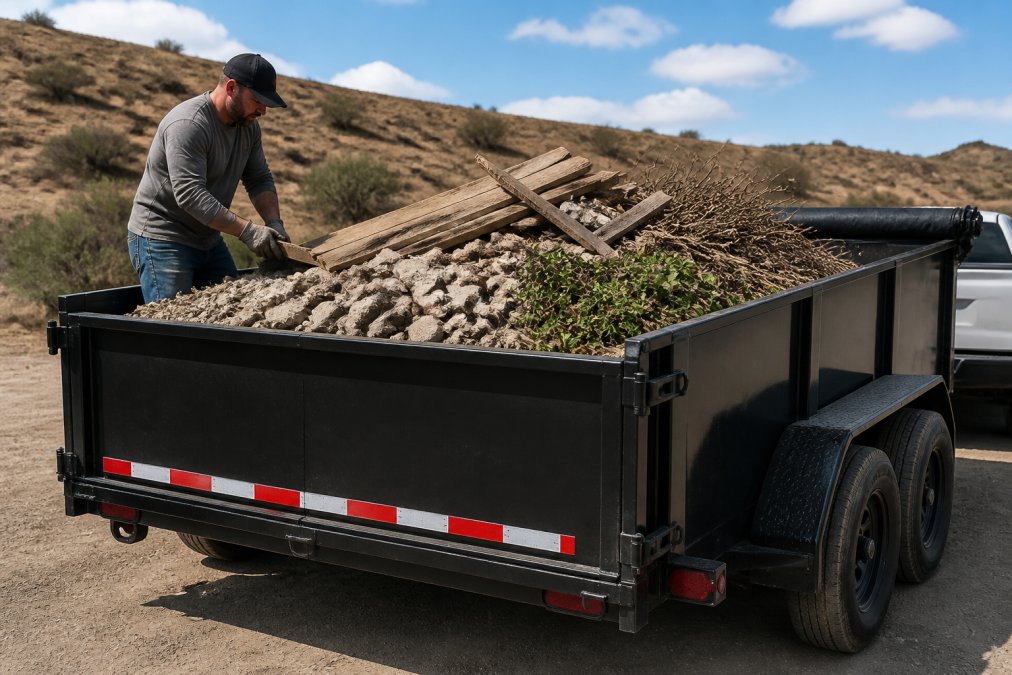
Common Loading Mistakes to Avoid
The most frequent mistake is overloading by weight while the trailer still has visible space. Cubic yard capacity and payload capacity are separate limits. A trailer that looks half-empty might already be at its weight limit. Always estimate material weight conservatively, especially with dense items like soil, concrete, or gravel.
Another common error is concentrating weight on one side or corner of the trailer, creating dangerous handling characteristics during transport and stress on one axle. Balanced distribution prevents these problems.
Loading materials too high or leaving them unsecured creates road hazards. Loose debris flies off during transport, potentially hitting vehicles behind you. Secure everything and keep loads below the trailer’s sides.
Finally, many people skip the hydraulic lift test before leaving the jobsite. Testing under load at the jobsite lets you reduce the load or call for help before transport.
Dump Trailer Rental vs Dumpster Rental: Which Option Fits Your Project
Both dump trailers and dumpsters solve debris removal problems, but they work differently and suit different project types.
A dumpster is a stationary container delivered to your property, left for a set period (typically 1-2 weeks), then picked up when full. A dump trailer is a mobile unit you rent, load yourself, transport to a disposal facility, and unload using the hydraulic lift.
Dumpsters work best for large, ongoing projects where debris accumulates over time. A kitchen renovation, roof replacement, or major demolition generates debris continuously over days or weeks. Dump trailers work best for projects with defined debris loads that you can move in one or two trips, such as yard cleanup or landscaping projects.
Key differences in cost structure: dumpsters charge a flat rental fee regardless of contents, while dump trailers charge a daily rental rate plus tipping fees at the disposal facility. If your local landfill charges $50 per ton and you’re hauling 10 tons, that’s an additional $500 in disposal costs.
Space is another consideration. Dumpsters occupy permanent space on your property for the rental period. If you have limited driveway or yard space, a dump trailer that you remove after one day is more practical.
Dumpsters also have restrictions on what you can throw away. Most prohibit hazardous materials, electronics, appliances, and certain heavy items. For most residential projects, a dump trailer is the more economical choice if your project generates a manageable volume of debris in a short timeframe.
Choosing the Right Trailer Size for Your Residential Cleanup
Selecting the correct dump trailer size requires estimating both the volume of materials and their weight. Undersizing means multiple trips; oversizing wastes rental money.
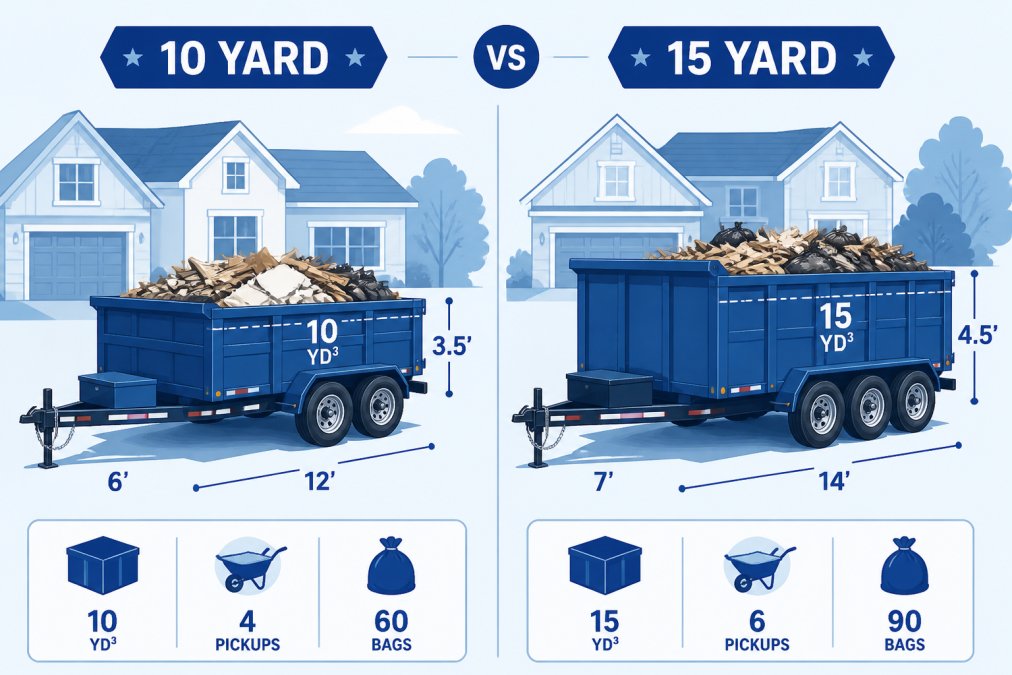
Most residential projects fit into three categories. A 10-cubic-yard dump trailer handles typical yard cleanups, small renovations, and landscaping projects. A 14-to-16-cubic-yard trailer works for larger renovations and substantial landscaping overhauls. A 20-cubic-yard trailer is for major projects, full-home renovations, or large demolition work.
To estimate the volume you need, visualize your debris pile. A 10-cubic-yard trailer holds roughly the equivalent of a small bedroom completely filled with debris. Weight matters as much as volume. Soil, concrete, and gravel are heavy. A 10-cubic-yard load of soil can weigh 10,000 to 12,000 pounds. If you’re hauling dense materials, you might need a larger trailer with higher payload capacity, even if the volume seems manageable.
Consider your towing vehicle’s capacity too. Every vehicle has a maximum towing capacity listed in the owner’s manual. A dump trailer’s Gross Vehicle Weight Rating (when fully loaded) must not exceed your vehicle’s towing limit. When you contact Urgency Trailer Rentals, describe your project type and materials. The team can recommend the right size based on experience with similar projects.
Safety Guidelines and Regulations for Towing and Dumping
Towing a loaded dump trailer safely requires attention to vehicle limits, road regulations, and proper equipment setup. Dumping at disposal facilities has its own rules.
Towing safety fundamentals: Your vehicle must have adequate towing capacity for the fully loaded trailer. Check your owner’s manual for the maximum towing weight, including the trailer plus all cargo. Install a brake controller if your trailer has electric brakes. A brake controller synchronizes the trailer’s brakes with your vehicle’s brakes, ensuring smooth deceleration and preventing jackknifing. Trailers over 3,000 pounds typically require electric brakes by law.
Check tire pressure and condition on both your vehicle and the trailer before towing. Secure the trailer hitch connection properly. The hitch ball must match the coupler size (typically 2 inches for residential trailers). Use a safety pin or clip to lock the coupler in place.
Road regulations: Most states require trailer lights to be functional: brake lights, turn signals, and reflectors. Some states require a separate braking system for trailers over a certain weight. Check your state’s regulations before renting. Urgency Trailer Rentals ensures all equipment meets local regulations.
Speed limits for towing are typically lower than regular traffic. Many states limit towing to 55 mph on highways. Respect these limits; higher speeds with a trailer create handling instability and increase stopping distance.
Dumping regulations: Before heading to a disposal facility, confirm what materials they accept and what tipping fees apply. Most facilities accept construction debris, yard waste, and general household items. They typically refuse hazardous materials, electronics, appliances, and treated wood.
Some facilities charge by weight, others by volume. Ask for the fee structure upfront. Follow the facility’s loading and dumping procedures. Operators monitor traffic flow and safety. Document the tipping fee receipt for your records.
Selecting the right dump trailer for a residential project comes down to matching trailer size and capacity to your specific needs and understanding the true costs involved. Urgency Trailer Rentals simplifies this process with personalized recommendations, free local delivery in the Bakersfield Metro area, and well-maintained equipment that includes securement items at no extra cost. Whether you’re tackling a yard cleanup, home renovation, or landscaping overhaul, the right trailer saves time, effort, and money. Book your trailer today and get your residential project moving.
Frequently Asked Questions
What size dump trailer do I need for a residential cleanup project?
Size depends on the volume and weight of debris. A 10-cubic-yard dump trailer works for small renovations and yard cleanups; 14-16 cubic yards suits larger projects like full room demolition or major landscaping. Calculate your debris volume by estimating how many pickup truck loads you'd need. Most residential projects fall between 10-16 cubic yards. Contact Urgency Trailer Rentals for a personalized recommendation based on your specific project details.
Is it cheaper to rent a dump trailer or hire a junk removal service?
Dump trailer rental is typically more cost-effective for large volumes of debris because you control the timeline and dumping fees. Junk removal services charge per item or by volume and handle hauling for you. For DIY projects where you have time to load and haul materials yourself, dump trailer rental usually costs less. For convenience and hands-off service, junk removal may justify the higher price. Pricing depends on quantity, dates, and delivery. Get a quote from Urgency Trailer Rentals to compare your specific situation.
Do I need a special driver's license to tow a dump trailer?
Most residential dump trailers fall under the standard passenger vehicle towing limit and don't require a commercial license. However, requirements vary by state and depend on the gross vehicle weight rating (GVWR) of the loaded trailer. If your trailer plus vehicle exceeds 26,000 pounds GVWR, you may need a commercial driver's license. Check your state's DMV regulations and verify your vehicle's towing capacity before renting. Urgency Trailer Rentals can advise on weight limits for your specific trailer and vehicle combination.
What items are prohibited from dump trailers, and how are disposal fees calculated?
Most dump sites prohibit hazardous materials (paint, batteries, oil, refrigerants), electronics, tires, and asbestos. Some restrict yard waste or concrete. Disposal fees vary by landfill and material type. General construction debris typically costs $30-$75 per ton, while yard waste may be free or lower. Confirm prohibited items and fee structures with your local landfill before loading. Urgency Trailer Rentals can guide you on what's accepted and help you plan accordingly to avoid surprise fees at the dump gate.
This article was written using GrandRanker