Table of Contents
- Trailer Rental vs Moving Trucks: The Cost Breakdown
- Open Utility Trailer vs Enclosed for Moving Furniture
- Towing a Trailer vs Driving a Box Truck
- Utility Trailer Rental Requirements and Vehicle Compatibility
- Hidden Costs: What Affects Your Final Price
- Which Option Wins for Your Move
- Conclusion
Last Updated: August 20, 2026
Trailer Rental vs Moving Trucks: The Cost Breakdown
When planning a move or hauling project, whether trailer rental cheaper options beat traditional moving trucks depends on your specific situation, load size, and towing vehicle. At Urgency Trailer Rentals, we help customers navigate this decision daily. The difference often lies in hidden costs most people don’t anticipate.
A trailer rental cheaper than a truck rental sounds appealing until you factor in towing vehicle requirements, fuel consumption differences, and insurance implications. This guide breaks down every cost component so you can make an informed decision without surprises at checkout.
According to the American Moving and Storage Association’s 2026 guidelines, understanding the full cost structure helps households avoid unexpected expenses during relocation.
Trailer Rental vs Moving Trucks: The Cost Breakdown
Open utility trailers and enclosed cargo trailers represent two distinct approaches to hauling, each with different cost profiles. An open utility trailer exposes cargo to weather and road debris but costs less to rent. An enclosed cargo trailer protects furniture and sensitive items but carries a higher daily rate.
The decision hinges on what you’re moving and how far. Local moves with weather-protected items favor enclosed trailers. Cross-country moves of hardy materials favor open utility trailers. Most rental companies charge more for enclosed models because they require more maintenance and offer better protection.
When comparing quotes, ask whether the rental includes tie-down straps, ratchet straps, and corner protectors. Urgency Trailer Rentals includes them at no additional cost, which can save money per rental.
Open Utility Trailer vs Enclosed for Moving Furniture
An open utility trailer is the bare-bones option: a flatbed or open-sided frame with no roof or walls. It’s lighter, which means better fuel economy when towing, and cheaper to rent. The downside is obvious, rain soaks your belongings, dust accumulates during transport, and highway wind can shift unsecured loads.
An enclosed cargo trailer solves these problems. Your furniture stays dry, clean, and protected from impact. The trade-off is weight (which increases fuel consumption), higher rental costs, and limited visibility when backing up. For valuable furniture or long-distance moves, the protection justifies the premium.
For someone moving a single bedroom’s worth of furniture across town on a clear day, an open trailer works fine if you secure everything properly. For someone moving heirloom pieces or multiple rooms, an enclosed trailer prevents costly damage that would exceed the rental price difference.
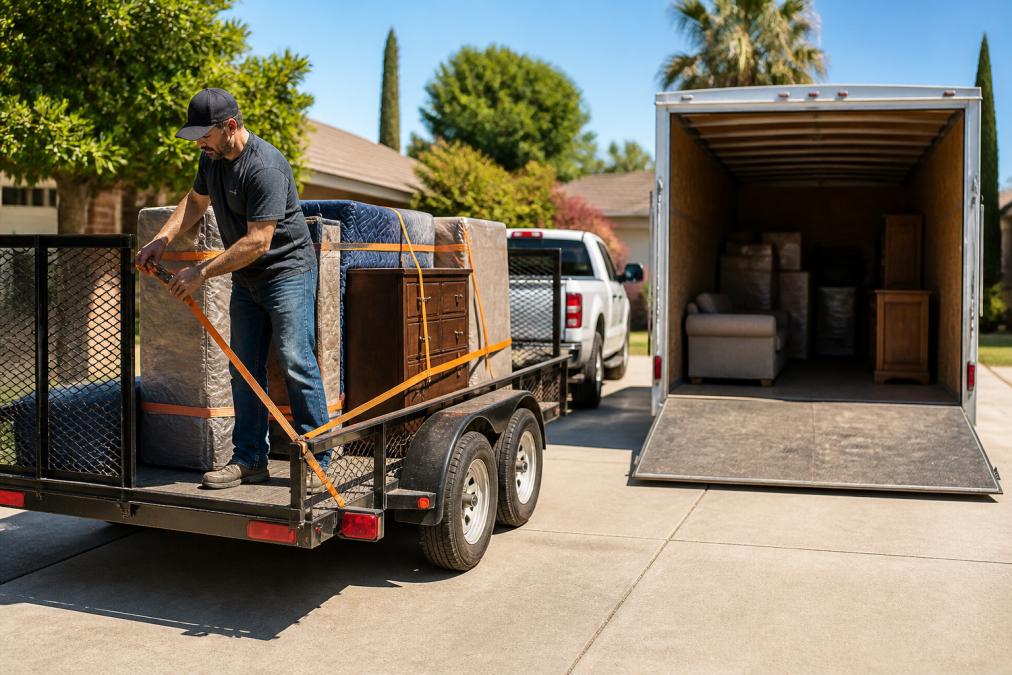
Enclosed trailers cost more upfront but protect high-value items from weather and road damage. Open trailers suit budget-conscious moves of durable items over short distances.
Towing a Trailer vs Driving a Box Truck
The fundamental difference is control and comfort versus cost and flexibility. Towing a trailer requires a personal vehicle with adequate towing capacity and a hitch receiver. Driving a box truck means renting a separate vehicle that you operate yourself.
When you tow a trailer, your truck or SUV must have a gross vehicle weight rating (GVWR) sufficient for the loaded trailer. Towing affects fuel economy significantly, causes trailer sway in crosswinds, and requires learned backing skills. Parking in tight spaces becomes impossible.
Driving a box truck eliminates these complications. You sit higher, see better, and control the entire load without worrying about trailer sway or hitch compatibility. Many box trucks come with ramps or lift gates, making loading easier. You don’t need a special vehicle, just a valid driver’s license.
The cost calculus flips when you factor in rental rates. Box trucks cost significantly more per day than trailers. For local moves, the truck’s higher rate might total less than a trailer plus fuel surcharges from towing. For long-distance moves, fuel costs for towing become competitive with truck rental rates, and the trailer wins.

For someone with a capable towing vehicle and basic mechanical knowledge, towing a trailer often proves cheaper. For someone uncomfortable with towing mechanics or lacking a suitable vehicle, a box truck provides peace of mind worth the premium cost.
Towing a trailer that exceeds your vehicle’s GVWR is dangerous and often illegal. Overloading causes brake failure, loss of control, and catastrophic accidents. Always verify your vehicle’s specifications before loading a trailer.
Utility Trailer Rental Requirements and Vehicle Compatibility
Before you can tow a trailer, your vehicle must meet specific requirements. The most critical is towing capacity, the maximum weight your vehicle can safely pull. This appears in your owner’s manual and on the driver’s side door jamb.
A hitch receiver is non-negotiable. Most vehicles have a 1.25-inch or 2-inch receiver. If your vehicle lacks a hitch, professional installation typically costs $150-$400. Trailers over 3,000 pounds typically require electric brakes that integrate with your vehicle’s brake system, adding another $300-$600. Smaller utility trailers under 3,000 pounds often use surge brakes, which require no additional wiring.
Tire condition and pressure become critical when towing. Your vehicle’s tires must be in good condition and properly inflated to handle the extra weight. Towing accelerates tire wear by 15-25%, meaning you may need replacement sooner than expected.
Lighting connections are mandatory. Your trailer must have working brake lights, turn signals, and tail lights that sync with your vehicle. A seven-pin or four-pin connector links your vehicle’s electrical system to the trailer. Wiring harnesses cost $30-$100 and installation takes 1-2 hours.
The Hidden Cost: Fuel and Wear and Tear
Most renters compare trailer rental rates to box truck rates and assume the trailer wins because the daily rate is lower. What they miss is the cost of operating the towing vehicle itself.
Towing increases fuel consumption by 20-40% depending on trailer weight and driving conditions. A vehicle that normally achieves 20 miles per gallon might drop to 12-16 mpg when towing a loaded trailer. On a 500-mile move, this difference is substantial. At current fuel prices around $3.50 per gallon, the extra fuel cost alone can reach $100-$200.
Wear and tear compounds the problem. Towing stresses your engine, transmission, brakes, and suspension. Brake wear accelerates significantly because trailer brakes share the load with your vehicle’s brakes. Industry estimates suggest towing adds $0.10-$0.15 per mile in accelerated wear and tear. On a 300-mile round-trip move, this translates to $30-$45 in additional vehicle maintenance costs.
Total Towing Vehicle Cost Calculation
Before committing to a trailer rental, calculate the true cost of your towing vehicle:
- Hitch installation (if needed): $150-$400 (one-time)
- Brake controller (if needed for heavy trailers): $300-$600 (one-time)
- Extra fuel for the move: Calculate based on distance, current fuel price, and expected mpg reduction
- Wear and tear: Estimate $0.10-$0.15 per mile × total miles driven
For example, a 400-mile round-trip move with a 25% fuel economy penalty and $0.12 per mile wear cost adds approximately $120 in fuel and $48 in wear, before you even pay the trailer rental fee.
Urgency Trailer Rentals recommends verifying your vehicle’s specifications and calculating total towing costs before booking. This prevents last-minute cancellations, rental fee disputes, and the unpleasant surprise of a move that seemed cheap until you factor in vehicle operating costs.
The National Highway Traffic Safety Administration provides detailed towing safety guidelines that outline weight limits and equipment standards for different vehicle classes.
Hidden Costs: What Affects Your Final Price
The advertised daily rate is just the beginning. Several factors inflate the final bill beyond what renters expect.
Standard Rental Surcharges
Mileage fees apply to many trailer rentals, though unlimited mileage is becoming more common. Late return fees penalize you for keeping the trailer beyond the rental period. A 30-minute grace period is standard, but after that, you’re charged for an additional rental day.
Cleaning fees apply if you return a dirty trailer, costing $75-$150. Delivery and pickup fees vary by location. Urgency Trailer Rentals includes free local delivery in the Bakersfield Metro area, eliminating this hidden cost. Equipment add-ons like tie-down straps, moving blankets, and corner protectors are sometimes free and sometimes charged separately. Clarify what’s included before booking.
The Critical Gap: Insurance and Liability Coverage
What most renters overlook is insurance, specifically, what your personal auto insurance actually covers when you’re towing a rented trailer.
Most standard personal auto insurance policies explicitly exclude coverage for rented or borrowed trailers. Your liability coverage, collision coverage, and comprehensive coverage typically do not extend to a trailer you’re towing, even if the trailer is hitched to your insured vehicle. This means if you cause an accident while towing a rented trailer, your personal insurance will deny the claim, leaving you personally liable for all damages.
Rental companies address this gap by offering optional damage waivers and liability protection plans. A damage waiver covers accidental damage to the rental trailer itself. Liability protection covers bodily injury and property damage you cause to third parties while towing the trailer.
Damage waivers typically cost $10-$25 per day. Liability protection plans cost $5-$15 per day. Together, these can add $15-$40 per day to your rental cost.
If you skip these protections and cause an accident, you face two liability scenarios:
-
Damage to the rented trailer: You’re liable for the full replacement or repair cost. A utility trailer might cost $2,000-$5,000 to replace. An enclosed cargo trailer can cost $8,000-$15,000.
-
Damage to third-party property or injury: If you hit another vehicle, injure someone, or damage property while towing the trailer, your personal auto insurance denies the claim. You become personally liable for medical bills, vehicle repairs, and legal fees, potentially tens of thousands of dollars.
Most insurers will not add coverage for a rented trailer without a specific endorsement, and many will not offer such an endorsement at all. Even if they agree, the cost often exceeds the rental company’s damage waiver.
Insurance Cost Calculation
For a 3-day trailer rental:
- Damage waiver: $15/day × 3 days = $45
- Liability protection: $10/day × 3 days = $30
- Total insurance cost: $75
Skipping these protections saves $75 on a 3-day rental but exposes you to potential liability of $5,000-$50,000+ if something goes wrong. Rental company protection plans are mandatory risk management.
Request a Complete Itemized Quote
Request a complete itemized quote that includes base rental, mileage (if applicable), damage waiver, liability protection, delivery, and any equipment fees. Comparing only the daily rate misleads you about true cost. A trailer rental that appears $30/day cheaper than a box truck becomes comparable once you add insurance protection and fuel surcharges.
Damage waivers and liability protection are essential financial safeguards. Budget $15-$40 per day for these protections and verify that your personal auto insurance does not cover rented trailers before signing a rental agreement.
Which Option Wins for Your Move
The answer depends on four variables: distance, load weight, your vehicle’s capability, and your comfort level.
Choose a trailer if: You own a vehicle with adequate towing capacity, you’re moving under 500 miles, you’re comfortable towing, and you want the lowest total cost.
Choose a box truck if: You lack a towing vehicle, you’re uncomfortable with towing mechanics, you’re moving more than 500 miles, or you prioritize comfort and convenience over cost.
Choose an enclosed trailer if: You’re moving valuable furniture, you’re transporting weather-sensitive items, and you have a capable towing vehicle.
Choose an open utility trailer if: You’re moving durable items like landscaping materials, equipment, or yard waste.
For most local residential moves under 50 miles, a trailer rental proves cheaper than a box truck when you factor in the full cost structure. For interstate moves or moves requiring maximum protection, a box truck often becomes competitive or cheaper despite higher daily rates.
Urgency Trailer Rentals helps customers evaluate this decision based on their specific project. The personalized approach beats one-size-fits-all recommendations because every move has unique constraints.
Consumer Reports’ moving cost analysis provides detailed breakdowns of how different rental options affect total moving expenses.
Conclusion
The question of whether is trailer rental cheaper than moving trucks has a conditional answer: it depends on your specific circumstances. Trailers win on cost for local moves with adequate towing vehicles. Box trucks win on convenience and safety for long-distance moves or when towing isn’t an option.
The real key is calculating your total cost: not just the daily rental rate, but mileage fees, fuel consumption, insurance, delivery, and equipment. A trailer that seems cheaper becomes expensive once you add surcharges. A box truck that seems expensive becomes reasonable when you eliminate hidden costs.
Frequently Asked Questions
Is trailer rental cheaper than moving trucks for most moves?
Trailer rentals typically cost less per day than moving trucks, but your total savings depend on your towing vehicle's fuel efficiency, rental duration, and distance. A fuel-efficient car towing a trailer may cost 30-50% less than renting a truck for a local move. However, if your vehicle has poor towing fuel economy or you lack a hitch, the advantage shrinks. Compare your specific vehicle's towing capacity and fuel efficiency against truck rental daily rates and mileage fees to determine actual savings for your move.
What are the hidden costs when renting a moving truck or trailer?
Moving trucks charge mileage fees on local rentals, damage waivers, fuel surcharges, and equipment fees for dollies or ramps. Trailer rentals may include unlimited mileage, but you pay for your towing vehicle's fuel, which varies by vehicle weight and engine type. Both options may charge drop-off fees at different locations, late return penalties, and insurance deductibles. Always confirm what's included in your quoted price and ask about damage assessment procedures, fuel policies, and any location-specific surcharges before booking.
Do I need a special vehicle to rent a utility trailer?
Yes. Your vehicle must have a hitch receiver (Class I, II, or III depending on trailer weight), a functioning electrical connector for trailer lights, and adequate towing capacity. Most trailers require a gross vehicle weight rating that accounts for the trailer plus cargo weight. Check your vehicle's owner manual for maximum towing capacity and hitch type. If your car lacks a hitch or has insufficient capacity, you'll need to rent a truck instead or install a hitch (which adds cost and time). Verify compatibility before committing to a utility trailer rental.
Is it easier to drive a moving truck or tow a trailer?
Moving trucks are generally easier for inexperienced drivers because you sit higher, have better visibility, and don't manage trailer sway or backing. Towing a trailer requires skill in reversing, weight distribution awareness, and understanding how trailer sway behaves at highway speeds. However, trailers are more maneuverable in tight spaces and easier to park in residential areas. Trucks demand more fuel and are harder to navigate narrow streets or tight parking. Choose based on your driving comfort, the move's location, and distance, trailers suit experienced towers; trucks suit those prioritizing ease and comfort.
What's the cheapest way to move your belongings?
For short-distance moves with a compatible towing vehicle, a utility trailer rental typically costs less than a moving truck. For long-distance moves, a truck with unlimited mileage may be cheaper overall because trailer fuel consumption compounds over hundreds of miles. For small moves, renting an enclosed cargo trailer protects items from weather and costs significantly less than a full truck. If you lack a towing vehicle, a truck is your only option. Get quotes from multiple providers for your specific move details, distance, cargo size, and duration, to find the true cheapest option.
When you’re ready to move forward with your project, Urgency Trailer Rentals offers personalized recommendations based on your load, distance, and vehicle capabilities. With free local delivery in the Bakersfield Metro area, unlimited mileage, and included securement equipment, we simplify the decision and keep your costs transparent. Book your trailer today and get the right equipment for your move without surprises.
This article was written using GrandRanker