Table of Contents
- What to Know About Enclosed Cargo Trailers for Moving
- Towing Capacity for Moving Trailers: Matching Your Vehicle
- How to Pack an Enclosed Trailer for a Move
- Enclosed Trailer Rental Cost Comparison: What Affects Your Price
- Choosing the Right Trailer Size for Your Move
- Safety Features and Cargo Security Standards
- What to Inspect Before You Rent
- Conclusion
Last Updated: August 16, 2026
What to Know About Enclosed Cargo Trailers for Moving
An enclosed cargo trailer rental is a fully-enclosed hauling solution that protects your belongings from weather, dust, and debris during transport. Unlike open utility trailers, enclosed models feature solid walls, a roof, and a lockable door, making them ideal for residential moves, furniture transport, and sensitive cargo. The key distinction comes down to protection and security: your items remain out of sight and locked inside during transit.
Most residential moves fall into the 6-by-12-foot or 7-by-14-foot range, offering between 500 and 700 cubic feet of usable space. A 500-cubic-foot trailer works for a studio apartment, while a 700-cubic-foot model handles a two-bedroom home more comfortably.
Before booking, measure your largest items, furniture, appliances, and artwork frames. Stack them mentally [in the](/benefits-of-trailer-rental-with-delivery/) trailer to visualize fit. This simple exercise catches sizing mistakes before rental day.
Towing Capacity for Moving Trailers: Matching Your Vehicle
Your vehicle’s towing capacity determines which enclosed cargo trailer rental you can legally and safely pull. This is a hard limit defined by your vehicle’s manufacturer specifications. Exceeding it voids warranties, creates liability exposure, and risks catastrophic failure on the road.
Gross Vehicle Weight Rating and Payload Limits
Gross Vehicle Weight Rating (GVWR) is the maximum weight your vehicle can safely carry, including passengers, fuel, and cargo. Your vehicle’s door jamb sticker lists this figure. Subtract your vehicle’s curb weight (empty weight) to find your actual payload capacity.
An enclosed cargo trailer rental typically has a tare weight (empty weight) of 2,000-3,500 pounds. Add your cargo weight to the trailer’s tare weight; that total cannot exceed your vehicle’s towing capacity. For example, a 6-by-12-foot enclosed trailer weighs roughly 2,400 pounds empty. If you load 3,600 pounds of furniture and boxes, the total is 6,000 pounds, your vehicle must have at least 6,000 pounds of towing capacity.
Most pickup trucks handle 5,000-14,000 pounds of towing capacity. Midsize SUVs typically manage 3,500-6,000 pounds. Sedans and compact vehicles often max out at 1,500-3,500 pounds. Check your owner’s manual or the manufacturer’s website for your exact specification. When in doubt, call Urgency Trailer Rentals; our team can match your vehicle to the right enclosed cargo trailer rental size instantly.
Hitch Size and Wiring Requirements
Your vehicle’s hitch receiver determines which trailer coupler you can use. Standard hitch sizes are 1.25 inches, 2 inches, and 2.5 inches. The trailer’s ball mount must match your receiver size exactly.
Most enclosed cargo trailers use a 2-inch hitch receiver and a standard 2-inch ball mount. Verify your vehicle’s hitch size before renting. The hitch ball itself comes in 1⅞-inch or 2⅛-inch diameters and must match your trailer’s coupler.
Your vehicle’s electrical system powers the trailer’s brake lights, turn signals, and running lights. A 4-pin connector handles basic lighting for smaller trailers. A 7-pin connector adds electric brake control, essential for heavier enclosed cargo trailer rentals.
Mismatched hitch sizes or improper wiring connections cause separation and brake failure. Before renting, confirm your vehicle’s hitch type and wiring capacity with your owner’s manual or a dealer.
How to Pack an Enclosed Trailer for a Move
Strategic packing inside an enclosed cargo trailer rental determines whether your move succeeds or fails. Poor weight distribution causes trailer sway, uneven tire wear, and brake problems. Improper cargo securing leads to shifting loads that damage items and create safety hazards.
Weight Distribution and Load Securement
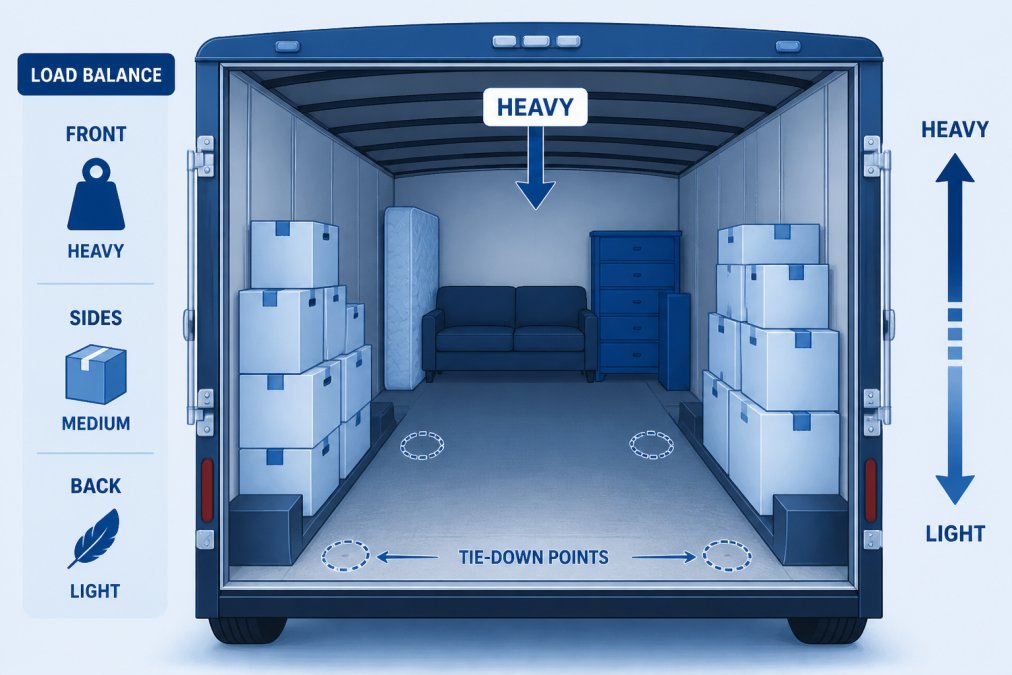
Place 60% of your weight in the front half of the enclosed cargo trailer rental, closer to the hitch. This prevents trailer sway and keeps weight balanced over the towing vehicle’s rear axle. Heavier items, appliances, dressers, boxes of books, go forward. Lighter boxes and soft goods go toward the back.
Position your heaviest furniture pieces first. A refrigerator, stove, or large dresser should sit within the front third of the trailer, centered side-to-side. Fill gaps with medium-weight boxes, and reserve the back quarter for lightweight items: pillows, blankets, lampshades, and empty boxes.
Don’t stack boxes higher than your eye level. Tall stacks become unstable during acceleration, braking, and turns. Distribute boxes across the trailer’s width to spread load evenly.
Tie-Down Points and Cargo Protection
An enclosed cargo trailer rental includes tie-down points, metal D-rings or anchor points bolted to the interior walls. Use these with ratchet straps or cargo nets to secure furniture and heavy items, preventing shifting during transit.
Wrap furniture edges with blankets or moving pads before securing. Ratchet straps are tight and can damage upholstery if applied directly. Boxes should be stacked tightly to prevent movement; use cargo nets to hold box stacks in place.
Distribute straps across multiple anchor points rather than overloading a single tie-down. A typical 6-by-12-foot enclosed cargo trailer rental has 8-12 tie-down points. Use at least 4-6 for securing major furniture pieces.
Enclosed Trailer Rental Cost Comparison: What Affects Your Price
Rental pricing for an enclosed cargo trailer rental depends on several factors beyond the daily rate. Understanding what drives costs helps you budget accurately and avoid surprises at checkout.
Daily, Weekly, and Monthly Rental Options
Most rental companies offer three pricing tiers: daily, weekly, and monthly rates. Daily rates typically run highest per day. Weekly rates offer better per-day value, and monthly rates provide the steepest per-day discount, ideal for longer moves.
Trailer size affects pricing significantly. A 6-by-12-foot enclosed cargo trailer rental costs less than a 7-by-14-foot model. Rental duration also matters: a three-day move may qualify for a weekly rate, which often beats paying three daily rates. Seasonal demand influences availability and pricing; summer months (May-August) see peak moving activity, while off-peak months (November-March) may yield better pricing.
Hidden Costs and Insurance Considerations
Beyond the base rental rate, several additional costs can appear on your final bill. Mileage fees apply if you exceed unlimited-mileage terms. Delivery fees may apply if you rent outside the local service area, though Urgency Trailer Rentals includes free local delivery in the Bakersfield Metro area.
Damage waivers and insurance are critical. A standard rental agreement holds you responsible for any damage to the trailer. Damage waivers, optional insurance, typically cost 10-15% of your rental rate but provide peace of mind. Late return fees apply if you keep the trailer beyond your agreed return time.
Equipment charges sometimes appear for items like moving dollies, furniture pads, or tie-down straps. Urgency Trailer Rentals includes securement items at no extra cost, eliminating surprise fees.
The lowest advertised daily rate isn’t always the best deal. Compare total costs including mileage, delivery, insurance, and equipment. Urgency Trailer Rentals’ inclusive approach often results in lower total costs despite comparable daily rates.
Choosing the Right Trailer Size for Your Move
Selecting the correct enclosed cargo trailer rental size prevents costly mistakes: undersizing forces multiple trips, while oversizing wastes money on unused capacity.
Cubic Feet and Cargo Capacity by Apartment Size
A studio apartment typically contains 1,500-2,500 cubic feet of belongings. A 6-by-12-foot enclosed cargo trailer rental (approximately 500-600 cubic feet usable space) often requires supplemental packing or a second trip. A 7-by-14-foot model (650-750 cubic feet) handles most studio moves in one trip.
A one-bedroom apartment averages 3,000-4,500 cubic feet of possessions. The 7-by-14-foot enclosed cargo trailer rental is the minimum recommendation. Two-bedroom apartments typically exceed 5,000 cubic feet of belongings; an 8-by-16-foot enclosed cargo trailer rental is standard.
Three-bedroom homes often require 8-by-20-foot or larger models. Measure your largest items and visualize them in the trailer, leaving 15-20% extra space for packing efficiency.
One-Way Rentals vs. Local Moves
A local move uses a one-way rental where you pick up the trailer locally and return it to the same location. Local moves work well for short-distance relocations within the same metropolitan area.
A one-way rental means picking up the trailer at one location and returning it to a different location. This is ideal for long-distance moves but typically costs more due to repositioning fees. For moves within the Bakersfield Metro area, Urgency Trailer Rentals’ local rental model with free delivery often beats one-way pricing from larger national companies.
Safety Features and Cargo Security Standards
An enclosed cargo trailer rental protects your belongings through design features that open trailers lack. Solid aluminum or steel walls, a metal roof, and a lockable rear door protect cargo from weather exposure, UV damage, and theft.
Tie-down points are welded anchor locations designed to handle the lateral and forward forces created by acceleration and braking. Proper use prevents cargo shifting and protects the trailer’s structural integrity.
Lighting systems include taillights, brake lights, and turn signals wired to your towing vehicle. Verify all lights function before departing; non-functional brake lights create liability and safety hazards.
Tire condition directly affects safety and stability. Check tire pressure before each use; most enclosed cargo trailer rentals require 50-65 PSI depending on tire specifications.
What to Inspect Before You Rent
A thorough pre-rental inspection protects you from liability for pre-existing damage and ensures the enclosed cargo trailer rental is roadworthy. Document everything before leaving the rental facility.
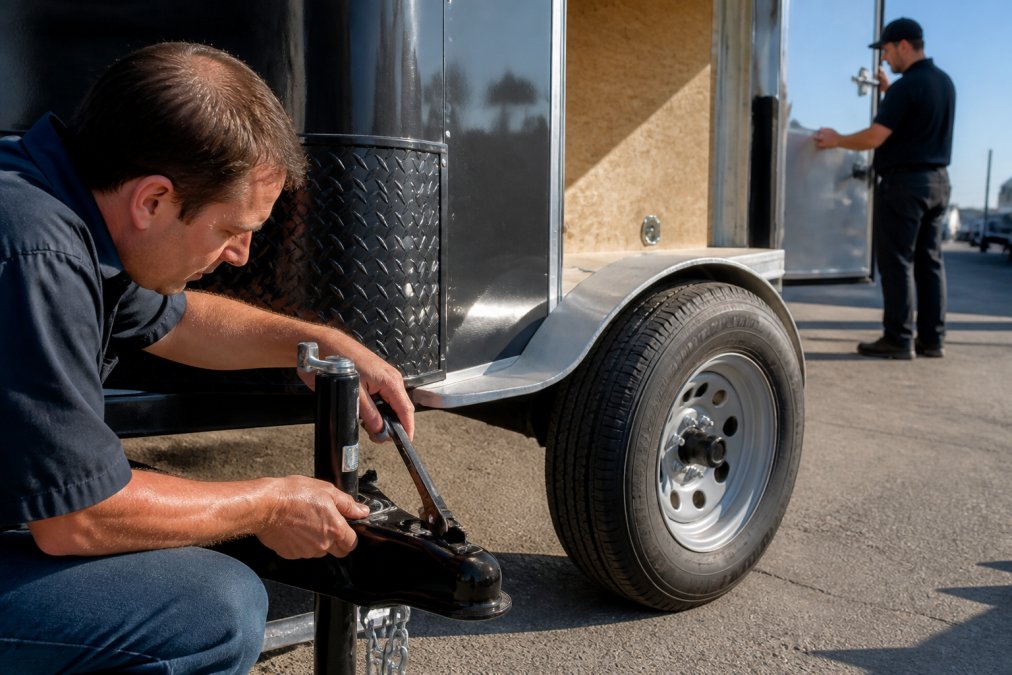
Walk around the entire trailer and note any visible damage: dents, scratches, rust, broken lights, or cracked windows. Take photos of the trailer’s exterior and interior. Check the tires for adequate tread depth (at least 4/32 inch) and proper inflation. Inspect the hitch ball, coupler, and safety chains for corrosion or damage.
Inside the trailer, verify tie-down points are intact. Test the rear door, it should open and close smoothly, and the lock should function. Check for interior damage: cracks in walls, missing padding, or debris.
Test the lighting system by connecting the trailer to your vehicle and verifying brake lights, turn signals, and running lights operate correctly. Document the odometer reading on your vehicle and note the fuel level. Record the rental agreement terms and get a copy of the damage inspection report.
Return the trailer in the same condition you received it (normal wear excepted). Clean out all belongings, sweep the interior, and return any included equipment. Return the trailer on time to avoid late fees.
Selecting the right enclosed cargo trailer rental starts with understanding your vehicle’s towing capacity, your cargo volume, and the specific features that matter for your move. Urgency Trailer Rentals simplifies this process through personalized recommendations, free local delivery in the Bakersfield Metro area, and included securement items that eliminate surprise fees. Our well-maintained trailers come with flexible daily, weekly, or monthly rental options. When you’re ready to move, contact Urgency Trailer Rentals for a quote tailored to your project needs.
Frequently Asked Questions
What size enclosed cargo trailer do I need for a one-bedroom apartment move?
A one-bedroom apartment typically requires 5,000 to 7,000 cubic feet of cargo capacity. Most single-bedroom moves fit comfortably in a 6×12 or 7×14 enclosed trailer. If you have significant furniture or extra belongings, consider a larger trailer to avoid multiple trips. Measure your largest furniture pieces and estimate box volume before renting to ensure adequate space.
Can my vehicle safely tow an enclosed cargo trailer for moving?
Your vehicle's towing capacity must exceed the trailer's gross vehicle weight rating (GVWR). Check your owner's manual or vehicle specifications for maximum towing capacity. Most sedans handle 1,500 to 3,500 pounds, while SUVs and trucks handle 5,000 to 14,000 pounds or more. Your hitch size (Class I, II, or III) must also match the trailer's requirements. When in doubt, contact the rental company for a compatibility check.
What's included in enclosed trailer rental cost, and are there hidden fees?
Rental pricing depends on trailer size, rental duration, and your location. Many providers include basic securement items like straps and tie-downs at no extra cost. Watch for potential additional charges: damage waivers, fuel surcharges, late-return fees, and delivery fees outside the local area. Ask the rental company upfront about all-inclusive pricing and what happens if you return the trailer late. Compare daily, weekly, and monthly rates to find the best value for your timeline.
Do I need a special license to tow a rental cargo trailer?
Most enclosed cargo trailers do not require a commercial driver's license if the combined weight of your vehicle and trailer stays under 26,001 pounds. However, licensing requirements vary by state. Some states require a CDL for trailers over 10,000 pounds GVWR. Check your state's Department of Motor Vehicles regulations before renting. The rental company can advise based on your vehicle and trailer combination, but verify your state's specific rules independently.
This article was written using GrandRanker