Table of Contents
- Why Proper Trailer Loading Matters
- Understanding the 60/40 Weight Distribution Rule
- Calculate Trailer Tongue Weight Correctly
- How to Secure a Load on a Utility Trailer
- How to Load a Motorcycle on a Car Hauler
- Final Safety Checks Before You Tow
- Common Loading Mistakes to Avoid
Last Updated: August 21, 2026
Why Proper Trailer Loading Matters
Improper trailer loading causes towing accidents, equipment damage, and cargo loss. Incorrect weight distribution forces your towing vehicle to work harder, reduces brake effectiveness, and destabilizes the trailer at higher speeds. Consequences range from tire wear and fuel waste to serious safety risks like jackknifing, trailer sway, or loss of control.
Proper loading protects your rental equipment, keeps you and others safe, and ensures cargo arrives intact. Whether hauling furniture, equipment, or vehicles, the fundamentals remain the same: balance weight, secure everything, and verify your setup before departure.
Before loading anything, check your rental trailer’s documentation for its gross vehicle weight rating (GVWR) and axle weight limits. Exceeding these can void insurance coverage and expose you to liability.
Understanding the 60/40 Weight Distribution Rule
The 60/40 weight distribution rule is the foundation of safe trailer loading: approximately 60% of your total cargo weight should sit forward of the trailer’s axles, and 40% behind them. This front-heavy bias maintains towing stability.
When too much weight sits behind the axles, tongue weight decreases. Tongue weight is the downward force the trailer exerts on your hitch. Low tongue weight makes the trailer prone to sway, dangerous fishtailing at highway speeds. Conversely, excessive weight over the hitch overloads your vehicle’s rear suspension and reduces steering and braking ability.
The 60/40 rule applies to utility trailers, enclosed cargo trailers, and general-purpose hauling. Car haulers and specialized equipment trailers may differ; consult your trailer’s manual.
To apply this rule, visualize an imaginary line through your trailer’s axles. Everything forward should represent roughly 60% of load weight; everything behind, 40%. For a 1,000-pound load, that’s about 600 pounds forward and 400 pounds back.
The 60/40 weight distribution rule prevents trailer sway and ensures proper tongue weight. Get this wrong, and your trailer becomes unpredictable at speed.
Calculate Trailer Tongue Weight Correctly
Tongue weight is the vertical downward force your cargo exerts on the hitch, measured in pounds and typically ranging from 10% to 15% of total cargo weight (fmcsa.dot.gov). A 1,000-pound load should produce 100-150 pounds of tongue weight.
Correct tongue weight is essential for safe towing. Too little causes sway; too much overloads your vehicle’s rear suspension, reducing steering response and braking power. Most towing vehicles have maximum tongue weight ratings of 300-500 pounds (nhtsa.gov). Check your vehicle’s owner’s manual.
To calculate tongue weight accurately, determine where your cargo’s center of gravity sits. For symmetrical loads, the center is roughly in the middle. For asymmetrical loads, the heavier side determines the center point. Cargo directly over the axles contributes zero tongue weight. Cargo forward of the axles contributes positive tongue weight. Cargo behind the axles reduces tongue weight.
Load your heaviest items first, positioning them forward of the axles, then add lighter items behind. This naturally creates proper weight distribution. If unsure, many hardware stores and truck scales can measure tongue weight for you. Weighing your loaded trailer before departure is insurance against disaster.
A common mistake: assuming tongue weight doesn’t matter if you’re under GVWR. Weight distribution and tongue weight are separate concerns. You can be well under GVWR and still have dangerous tongue weight imbalance.
How to Secure a Load on a Utility Trailer
Securing cargo is as important as loading it correctly. Unsecured cargo shifts during acceleration, braking, and turns, changing weight distribution mid-journey and making the trailer unstable. Cargo can fall off entirely, creating hazards for other drivers.
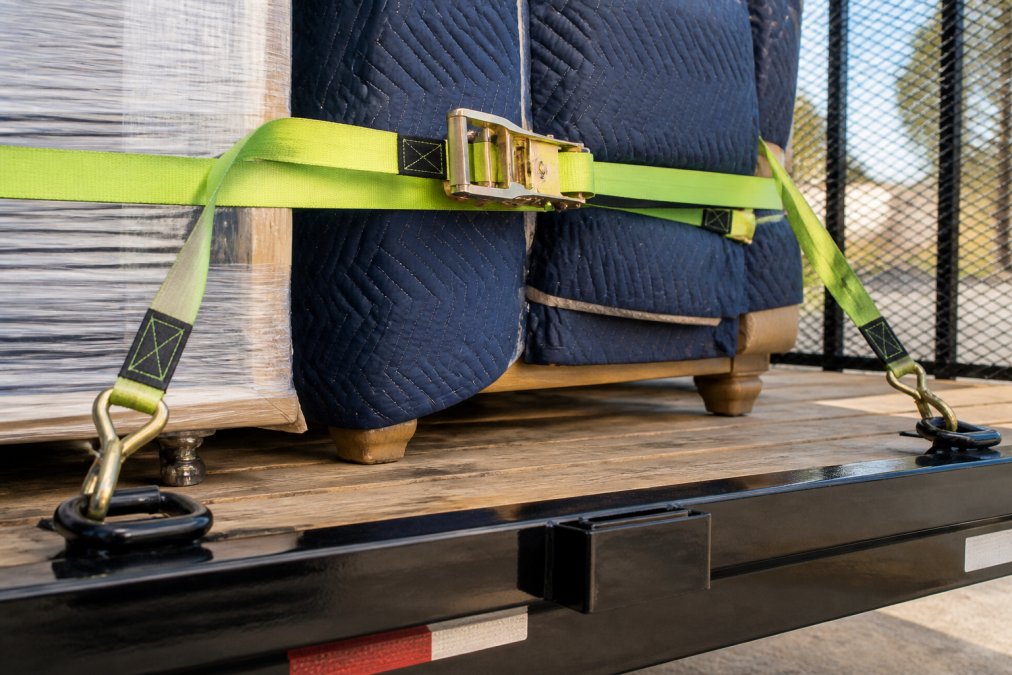
Effective cargo securement combines tie-down points, ratchet straps, and safety chains. Tie-down points are anchor locations built into your trailer’s frame, usually metal rings or D-rings. Ratchet straps loop around cargo and attach to these points, then tighten to hold everything in place. Quality ratchet straps have a working load limit (usually 1,000-5,000 pounds) appropriate for the weight they’re securing (osha.gov).
When securing cargo: use at least two tie-down points per load section, crisscross straps to prevent shifting, and tighten each strap evenly. The strap should be snug enough that you can’t move cargo by hand, but not so tight that it compresses or damages what you’re hauling.
For furniture and household items, wrap items first to prevent strap damage, then secure them. For equipment, use built-in tie-down points if available. For irregular shapes, use multiple straps at different angles; one horizontal strap alone won’t prevent movement during hard braking.
Safety chains are a legal requirement on most trailers. These backup securement devices connect your trailer to your towing vehicle and prevent complete separation if the hitch fails. Chains should have minimal slack, about 12 inches when the trailer is level, and should cross underneath the hitch tongue to form an X. This configuration prevents the tongue from dropping if the hitch fails.
Urgency Trailer Rentals includes securement equipment with every rental at no extra cost. Before departure, do a physical check: grab each piece of cargo and try to move it. If anything shifts, tighten your straps and recheck.
Unsecured cargo that falls onto the roadway can cause accidents, and you’re liable for any damage or injuries that result. This is both a safety issue and a legal one.
How to Load a Motorcycle on a Car Hauler
Loading a motorcycle on a car hauler requires a different approach than general cargo. Motorcycles are top-heavy, have a narrow wheelbase, and can tip easily if not positioned correctly. Car haulers have wheel chocks, ramps, and tie-down points specifically designed for vehicles.
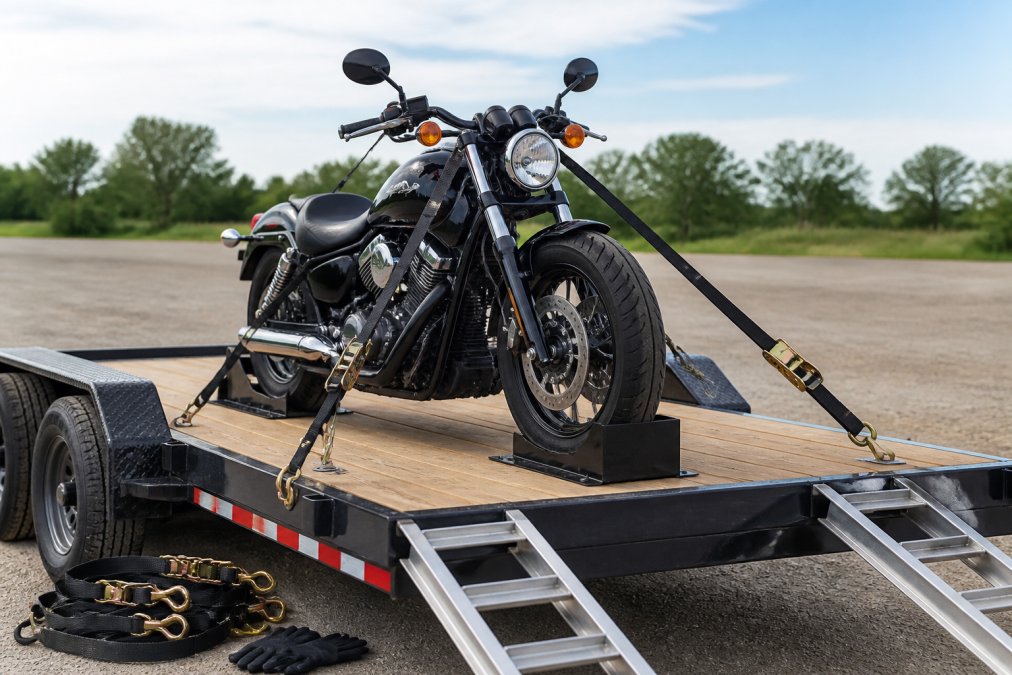
Position ramps at a shallow angle, about 15-20 degrees. Steep ramps make control difficult and increase the risk of the front wheel lifting off. Drive or push the motorcycle slowly up the ramp, keeping it centered and vertical. A second person spotting you is invaluable.
Once on the hauler bed, position the motorcycle between wheel chocks. The front wheel should sit firmly in the front chock, and the rear wheel in the rear chock. Wheel chocks prevent forward and backward movement but don’t prevent tipping, so additional tie-downs are necessary.
Use ratchet straps to secure the motorcycle’s frame to the hauler’s tie-down points. Never strap to handlebars or fenders, which can bend or break. Loop straps through the frame or around the swingarm. Use at least two straps, one on each side, pulling downward and outward toward the hauler’s tie-down points. This creates tension that prevents tipping.
Tighten each strap gradually and evenly. Over-tightening can bend the frame or compress suspension, so apply firm tension but not maximum force. The motorcycle should be immobile with no rocking or forward/backward movement.
For inoperable motorcycles, use a dolly or hand truck, or ask the rental company for guidance. Urgency Trailer Rentals’ car haulers come with winches and proper tie-down systems for vehicles.
Before departing, inspect every strap and chock. Give the motorcycle a gentle push to verify it doesn’t move. Check that no straps are twisted or rubbing against sharp edges.
Final Safety Checks Before You Tow
Before pulling onto the road with a loaded trailer, perform a systematic safety check. This takes 10 minutes and prevents most common problems.
Check tire pressure and condition. Both your towing vehicle and trailer tires should be at the pressure specified on the sidewall or in your vehicle’s manual. Underinflated tires generate excess heat, reduce fuel economy, and can fail at highway speeds. Inspect all tires for cuts, bulges, or uneven wear. Damaged tires should be replaced before towing.
Verify lights and safety chains. All trailer lights, brake lights, turn signals, and running lights, must function. Plug the trailer into your vehicle’s electrical connector and test each light. Check that safety chains are properly connected with minimal slack.
Confirm your load hasn’t shifted. Give each piece of cargo a physical push. Tighten any straps that have loosened. Walk the trailer perimeter and look for anything unstable or poorly secured.
Check hitch connection. Your trailer’s coupler should slide onto the ball hitch smoothly and lock securely. The locking pin or clip should be fully engaged. If the coupler wobbles or feels loose, do not tow.
Inspect brake function. If your trailer has brakes, confirm they work by backing up slowly and feeling resistance. Electric brakes should engage smoothly; hydraulic brakes should feel firm. If brakes feel spongy or unresponsive, have them serviced before towing.
Measure clearance. Confirm that your loaded trailer doesn’t exceed height, width, or length limits for your route. Bridges, overpasses, and narrow roads can catch overloaded or poorly loaded trailers.
Calculate your stopping distance. A loaded trailer significantly increases stopping distance. At highway speeds, you need more space to brake safely. Adjust your following distance and reduce speed in poor weather.
A 10-minute safety check before departure catches most problems before they become dangerous. This is the easiest insurance policy you can buy.
Common Loading Mistakes to Avoid
Understanding what goes wrong helps you avoid it. These mistakes are common, preventable, and dangerous.
Placing all weight at the back. This is the single most common error. Trailers loaded this way become unstable at speed and prone to sway. The 60/40 rule exists because decades of accident data proved it works.
Overloading the trailer. Your trailer has a GVWR, a maximum weight it can safely carry. Exceeding this rating stresses the frame, overloads the axles, and can cause structural failure. Check your trailer’s documentation and weigh your load before departure.
Ignoring tongue weight. Tongue weight that’s too light or too heavy creates towing problems. Too light causes sway; too heavy overloads your vehicle’s rear suspension and reduces steering response.
Securing cargo to the sides only. Straps running only along the sides don’t prevent forward or backward movement. Use straps that cross at angles to create three-dimensional securement resisting movement in all directions.
Using damaged or worn straps. Ratchet straps fray and lose tension over time. Inspect straps before use and replace any showing wear.
Stacking cargo unevenly. Uneven stacking creates an unstable center of gravity that shifts during acceleration and braking. Stack items evenly and secure them so they can’t topple.
Not checking equipment before loading. Worn tie-down points, missing wheel chocks, or damaged ramps become obvious problems once you’re on the road. Inspect your rental trailer thoroughly before loading and alert the rental company to any damage or missing equipment.
Properly loading a trailer safely is a skill that pays dividends every time you haul. The process requires understanding weight distribution, calculating tongue weight, securing cargo effectively, and performing safety checks before departure. When you follow these principles, your trailer stays stable, your cargo arrives intact, and you avoid accidents resulting from improper loading.
When you rent from Urgency Trailer Rentals, you get well-maintained equipment, included securement items, and the confidence that comes from knowing your trailer is ready for the job. Book your trailer today and load it with the knowledge that you’re doing it safely.
Frequently Asked Questions
Q: What's the 60/40 rule when loading a trailer?
A: The 60/40 rule means placing 60% of your cargo weight over or in front of the trailer axles and 40% behind them. This distribution prevents swaying and keeps the trailer stable during towing. Reversing this ratio causes the trailer to fishtail and become difficult to control, especially at highway speeds.
Q: How do you calculate trailer tongue weight?
A: Tongue weight is typically 10-15% of your total cargo weight. Multiply your loaded cargo weight by 0.10 to 0.15 to get the range. Always verify your trailer's maximum tongue weight capacity in the owner's manual and never exceed your towing vehicle's hitch rating.
Q: What are the signs of an improperly loaded trailer?
A: Watch for trailer sway (side-to-side movement), difficulty steering, excessive bouncing, or the trailer pulling to one side. These indicate unbalanced weight distribution or inadequate securement. Stop immediately, check your load, and redistribute cargo to correct the problem before continuing.
Q: How do you prevent a loaded trailer from swaying?
A: Prevent sway by distributing weight evenly side-to-side, keeping the center of gravity low, securing all cargo with ratchet straps or chains, and maintaining proper tongue weight. Reduce speed in windy conditions, avoid sudden steering movements, and ensure your towing vehicle's suspension and brakes are in good condition.
This article was written using GrandRanker